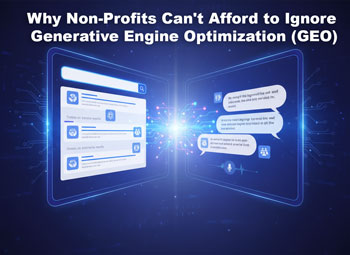
Generative Engine Optimization (GEO) is reshaping how nonprofits get discovered online. If your organization is still relying solely on traditional search-engine optimization (SEO), you’re running the risk of falling behind. The digital discovery landscape is shifting fast. We’re moving from “search engines” to “answer engines” or “generative engines”. Clarifying this shift and acting on it now can make the difference between your not-for-profit organization being found or effectively becoming invisible online.
The Shift You Need to Know About
Traditionally, organizations have optimized their websites so that when someone types a query into a search engine, think Google or Bing, their content appears somewhere on the search results page. That’s SEO: keywords, links, authoritative domains, page rank. But today, more users are turning not to “search pages” but to generative AI-powered assistants, chatbots, or voice-activated devices. These tools answer questions directly for the user, often without the user ever clicking through to a website. This is where Answer Engine Optimization (AEO), or Generative Engine Optimization (GEO) come in.
For non-profits, this matters for two big reasons:
Your audience may be looking for you in ways you’re not prepared for.
The rules for being discovered are changing. If you don’t adapt, you’ll get left behind.
Why Non-profit Organizations Must Care
As a non-profit, your mission is not to sell a product, but to raise awareness, to foster engagement, to find supporters, and to mobilize communities. That means being found by the right people, at the right time, in the right way. If your visibility drops because you’re relying on old methods, your capacity to fulfill your mission is harmed. On the flip side, those organizations that figure out how to show up in the new “Answer Engine” or “Generative Engine” world will gain a competitive edge in awareness, impact, and reach.
What’s Changed Under the Hood
Here’s how AEO differs from old-style SEO:
Format & Intent: Instead of optimizing for an algorithm that lists links, you optimize for a system that summarizes or answers questions directly.
Structure & clarity: AI systems reward content that is clearly structured, marked up (schema, headings, FAQs), and contextually relevant.
Authority & trust: With AEO or GEO, being cited as a trusted source matters more than just ranking high on a page. AI “chooses” to reference your content.
Behavior shift: Users ask “What is…” “How do I…” “Where can I…” rather than typing a list of keywords. Voice, conversation, long-form queries grow.
What this Means for You
As a non-profit operating in a competitive space for attention, time, and resources, here are the action steps:
Audit your content: Review your website and content library with the question: “If someone asked a voice assistant ‘How does your organization support X?’, would your content deliver a crisp, direct answer?” If not, there’s a gap.
Structure for machine-readability: Use heading tags (H1, H2), FAQs, schema markup, clear definitions. Break content into answer-ready chunks.
Focus on questions your audience asks: Think in terms of “What does someone in our community ask when they’re exploring our field?” Then craft content specifically answering that question.
Build trust and citations: Strengthen your domain credibility, ensure your content is referenced, linked, and clearly associated with your brand. For non-profits this often means partnerships, authoritative mentions, and transparent data.
Integrate SEO + AEO/GEO: Don’t discard SEO, it’s still foundational. But layer in AEO/GEO so your content is ready for AI-driven discovery. As one recent analysis put it: “SEO helps you rank; AEO helps you become part of the answer.”
Why Wait no Longer
If you delay, you risk losing visibility. The early adopters of this shift will capture attention in a digital ecosystem where many are still playing by old rules. One blog headline nailed it: “SEO is dead. Your business is invisible without AEO.” For a non-profit that depends on being found, that’s a serious red flag.
Conclusion
In short, your non-profit’s ability to serve depends not just on doing great work, but also depends on being discovered. The digital search and discovery landscape is evolving. If you want to be one of the organizations that gets found in 2026 and beyond, you need to shift beyond traditional SEO and embrace AEO, or what they call also GEO.