Zakat is one of the five pillars of Islam, but knowing whether you owe it—and how much—requires understanding a concept that confuses many Muslims: the nisab.
The Zakat Nisab 2026 threshold determines whether your wealth has reached the level where zakat becomes obligatory. Get this number wrong, and you might pay zakat when you don’t need to, or worse, fail to pay when you’re required to.
Here’s what you need to know.
What Is Nisab and Why Does It Matter?
Nisab is the minimum amount of wealth a Muslim must possess before zakat becomes obligatory. It’s essentially a threshold: if your zakatable wealth exceeds the nisab and you’ve held it for one full lunar year (called the hawl), you owe 2.5% of that wealth in zakat.
The nisab serves an important purpose. Islam doesn’t require those who are struggling financially to give zakat—they may actually be eligible to receive it. The threshold ensures that only those with sufficient wealth beyond their basic needs are obligated to purify their wealth through this pillar.
The nisab is traditionally measured against gold or silver, which is where things get interesting.
Zakat Nisab 2026: Gold vs. Silver Thresholds
The nisab can be calculated using either gold or silver as the standard:
Gold Nisab:
- 87.48 grams of gold (approximately 2.81 troy ounces)
- At current gold prices: approximately $7,500–$8,500 USD
Silver Nisab:
- 612.36 grams of silver (approximately 19.69 troy ounces)
- At current silver prices: approximately $1,500–$1,800 USD
Note: Precious metal prices fluctuate daily — and have been especially volatile in early 2026. Always check current spot prices when calculating your nisab. Prices above are approximate as of February 10, 2026.
Notice the dramatic difference. The gold nisab is roughly 12-15 times higher than the silver nisab. This isn’t a calculation error—it reflects how the relative values of gold and silver have shifted since the time of the Prophet ﷺ.
Which Threshold Should You Use?
This is where scholarly opinion varies, and you should consult with your preferred Islamic authority.
Many contemporary scholars recommend using the silver nisab (the lower threshold). Their reasoning: using the lower threshold means more Muslims fulfill their zakat obligation, which means more funds reach those in need. When in doubt, the more cautious approach benefits the recipients of zakat.
Other scholars argue for using the gold nisab, noting that gold has historically been the more stable measure of wealth and better reflects the original intent of exempting those without significant means.
If your wealth falls between the silver and gold thresholds, this decision matters significantly. If you have $3,000 in zakatable assets, you owe zakat under the silver standard but not under the gold standard.
When uncertain, consult a scholar you trust—and remember that erring on the side of giving is never a spiritual loss.
What Counts as Zakatable Wealth?
Not everything you own is subject to zakat. Here’s what typically counts:
Zakatable:
- Cash (checking, savings, money market accounts)
- Gold and silver (jewelry, bullion, coins)
- Investments (stocks, mutual funds, retirement accounts—scholars differ on details)
- Business inventory and merchandise
- Loans owed to you that you expect to collect
- Rental income and business profits
Typically Not Zakatable:
- Your primary residence
- Personal vehicles
- Household furniture and appliances
- Clothing and personal items
- Tools and equipment used for your profession
The key distinction: wealth that is productive, liquid, or held for growth generally qualifies. Assets you use for daily living generally don’t.
The Hawl Requirement
Owning wealth above the nisab isn’t enough by itself. That wealth must also be held for one complete lunar year (hawl) before zakat becomes due.
This means if you receive a large bonus in January but your zakat calculation date is in March, that bonus won’t be included until next year’s calculation—assuming you still have it.
Many Muslims simplify this by choosing a fixed date each year (often during Ramadan) and calculating their zakatable wealth on that date. If you’ve held wealth above the nisab since your last calculation date, you owe 2.5%.
Calculating Your Zakat: A Simple Framework
Once you’ve determined you meet the Zakat Nisab 2026 threshold and hawl requirement:
- List all zakatable assets (cash, investments, gold, silver, receivables, etc.)
- Subtract any debts that are immediately due
- Multiply the total by 2.5% (or 0.025)
That’s your zakat obligation.
For example: $50,000 in savings + $30,000 in investments + $5,000 in gold – $10,000 in immediate debts = $75,000 × 0.025 = $1,875 in zakat.
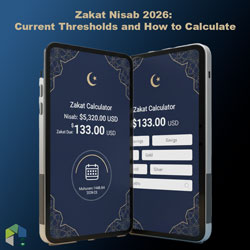
Calculate your zakat now with our free Zakat Calculator — then explore our Muslim Philanthropy resources to learn more about the principles behind zakat.
Common Zakat Mistakes to Avoid
Forgetting retirement accounts: Many scholars include 401(k)s and IRAs in zakatable wealth, even if you can’t access them without penalty. Consult a scholar on this.
Ignoring gold jewelry: That necklace you never wear still counts. Weigh it, calculate the value.
Using outdated nisab figures: Gold and silver prices change daily. The Zakat Nisab 2026 values differ from previous years. Always use current spot prices when calculating.
Calculating on wealth you don’t have: If you spent it, it’s not zakatable. Calculate based on what you actually possess on your calculation date.
Waiting for “the perfect time”: If you owe zakat, it’s due. Many Muslims pay during Ramadan seeking multiplied rewards, but don’t delay if your hawl has already passed.
When to Pay Your Zakat
Zakat becomes obligatory once the nisab and hawl conditions are met. You shouldn’t delay payment.
That said, many Muslims choose to calculate and pay their zakat during Ramadan. The blessed month’s multiplied rewards make it a spiritually strategic time for this obligation. If you set your annual calculation date during Ramadan, you align your zakat with the month of increased worship and generosity.
Just ensure you’re not delaying a payment that was already due. If your hawl was complete in November, pay in November—or at least pay what you owed then and recalculate in Ramadan.
Make Your Zakat Count
Understanding the Zakat Nisab 2026 thresholds is the first step. The next is ensuring your zakat reaches those who need it most, distributed to eligible recipients according to Islamic principles.
AMCF has distributed over $26 million to more than 1,000 nonprofits serving Muslim communities and beyond. When you give through AMCF, you’re partnering with an organization that understands both the spiritual weight and practical logistics of zakat distribution.
Calculate your zakat now → | Explore our Muslim Philanthropy resources
Jazaakumul Lahu khayran
As salamulaykum. I am seeing your silver nisab is $500to 600 while what I have come to that silver price has gone up this year tremendously. So it is around 1500 to 1800us dollars. Cam you explain it please
. Why you that nisab
Walaikum assalam, and jazakAllah khair for catching this! You’re absolutely right — silver prices have increased dramatically this year (currently around $80-85/oz), which significantly affects the nisab calculation.
At current prices, the silver nisab (612.36g) is approximately $1,500-$1,700 USD, not the $500-600 we originally listed. We’re updating the blog post to reflect current values.
This is exactly why we recommend checking live precious metal prices when calculating your zakat, as these thresholds can shift significantly. Our zakat calculator uses current values to help you calculate accurately.
JazakAllah khair again for the correction — this kind of feedback helps us serve the community better.